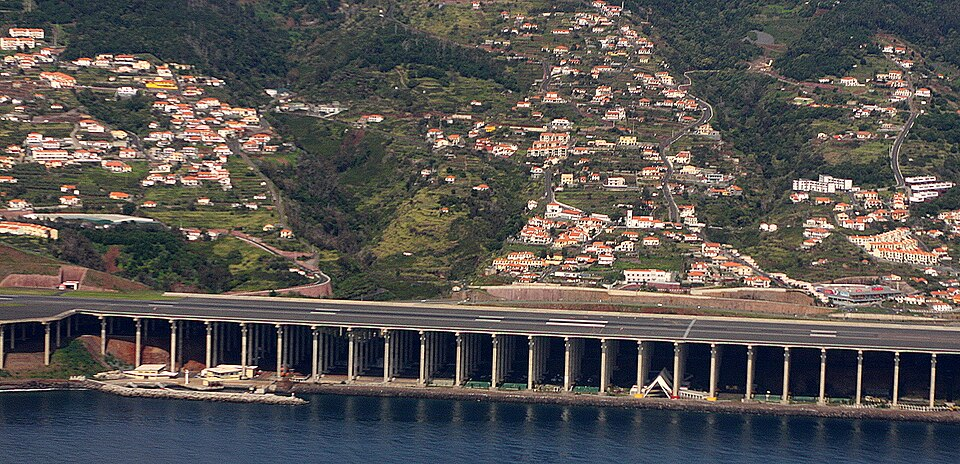
When Portugal privatised its airport operator ANA in 2012, the French infrastructure group Vinci took on a 50-year concession covering essentially the country's entire civil aviation network: Lisbon, Porto, Faro, Madeira, Porto Santo, four Azorean airports, and the civil terminal at Beja. Fourteen years on, that single decision sits behind three arguments playing out this summer. The political pressure on the concessionaire is real. Whether the concessionaire is the right target varies sharply from case to case, and in the case generating the most heat, it mostly isn't.
Madeira: airlines eye the exit
The most urgent chapter is Madeira. António Trindade, chairman of the PortoBay hotel group, warned this month on TSF-Madeira's Debate da Semana that tour operators and airlines are weighing whether to suspend Madeira operations from 2027. Wind closes Funchal's airport, Trindade said, in almost every month of the year, his description, from his vantage point in the industry. When closures happen, the costs of diversions, cancellations, extra fuel, alternate-airport fees and stranded-passenger hotels fall on the carriers and the tourism sector. Trindade told the programme his group, which he put at roughly 4% of the island's hotel capacity, lost €100,000 in revenue in a single three-day stretch of closures last month, his own figures, from his own company's books, not independently audited ones.
It is worth being precise about why those costs land where they do, because it is easy to read this as a grievance against the airport operator. It isn't one. Under EU passenger-rights law, an airline's duty of care to stranded passengers, meals, accommodation, re-routing, applies even when the disruption is caused by weather beyond the airline's control. Bad weather exempts a carrier from paying compensation; it does not exempt it from paying for hotels. No airport operator anywhere insures airlines against wind. The dispute in Madeira is not that Vinci is dodging a bill it owes. It is that the bill is large, recurring, rising, and nobody has agreed who should carry it.
The number is older than the runway
Funchal is one of the hardest airports in Europe to fly into, and always has been. It sits on a coastal shelf beneath a mountain; wind funnels and shears across the runway thresholds. No amount of terminal investment changes that geography.
But the thing that actually closes the airport is not, in the first instance, the wind. It is a number.
Madeira's published wind limits, 15 knots mean, 25 knots gust, are mandatory, not advisory. At most airports, published limits are guidance and the captain in command decides. At Funchal, a commander who judges the conditions safe may not land if the wind is over the limit.
Those limits were set in 1964, on the basis of tests flown with a Douglas DC-3, a Second World War transport aircraft, when the runway was 1,600 metres long. The runway is now 2,781 metres and differently oriented. The limits have not moved.
And a Ministry of Infrastructure working group, set up in January 2021 and coordinated by Frederico Pinheiro, reported that in roughly 80% of diversions the wind on approach was only about three knots over the limit.
Set that beside a second figure. Average wind speeds at the airport have risen by about three knots over the past decade, a change Secretary of State for Infrastructure Hugo Espírito Santo has said "invalidates a large part of operations," and which IPMA and the national civil engineering laboratory LNEC have been instructed to investigate. The two numbers measure different things and one does not cause the other. Read together, they describe how narrow the operating margin at Funchal has become: the wind has risen by roughly the same amount that separates most diverted flights from a landing.
The limits at Funchal are mandatory, not advisory, and the number was set in 1964, using a DC-3, on a runway barely half today's length.
A word of caution about a claim you will see everywhere. Portuguese coverage of this row often states flatly that Madeira is the only airport in the world with mandatory rather than advisory wind limits. Portugal Dispatch is not repeating that claim as established fact. It originates with Carlos Rodrigues, a PSD deputy who chairs the Madeira parliamentary committee pressing for the limits to change, and has been reproduced across the national press as agency copy, which creates the appearance of many sources where there is really one. When Diário de Notícias da Madeira put the claim directly to APPLA, the Portuguese airline pilots' association, APPLA declined to confirm it: it said it could not be categorical, that another airport somewhere might have imposed limits, and that it simply knew of none with the same arrangement. Madeira's mandatory limits are certainly unusual. "Unique in the world" is an advocate's claim, not an established fact.
And the pilots don't want them changed
Here the story resists the obvious conclusion, and readers should have the counter-argument in full rather than a strawman of it.
ANAC, the national civil aviation authority, and not ANA or Vinci, holds the power to revise the limits. NAV Portugal, the state air navigation provider, has confirmed as much in parliamentary testimony: the decision is ANAC's.
ANAC has declined to relax them. Its president, Tânia Cardoso Simões, has said the authority is entirely willing to review the limits, but only on the basis of scientific data, and that they should not be altered until there is scientific proof to justify it. She has cautioned against creating expectations, noting that climatic conditions are deteriorating, and rejected the idea that adding a knot or three would resolve much. On the argument that experienced commanders should be trusted to judge for themselves, her answer was pointed: pilots have autonomy and should be heard, but they are human, and subject to pressure too.
APPLA, the pilots' association, has gone further, arguing the limits should hold and that the airport should close when they are exceeded.
Against them: experienced Madeira commanders, including a retired pilot with over nine thousand landings at Funchal, who consider the limits arbitrary; and the working group's finding that in most diversions, pilots reported normal stability on approach and were grounded by the number rather than the conditions.
This is a real technical dispute between the people who fly the approach and the people who regulate it, and Portugal Dispatch is not in a position to adjudicate it. It is also, on a runway where Portugal's worst aviation disaster happened in 1977, not a dispute anyone should want settled by commercial pressure.
What matters here is narrower and not contested: the decision belongs to a state regulator. ANA cannot make it. Vinci cannot make it. Nor can the regional government, which has lobbied for revision for the better part of a decade, under successive PSD administrations, without success.
The mitigation technology isn't Vinci's either
MAD Winds, a €3.5 million system combining X-band radar with LIDAR to detect windshear and turbulence in near-real time across a radius of more than ten kilometres, was recommended by that same 2021 working group. It was procured by NAV Portugal, whose acquisition process was delayed by the pandemic and by financial constraints, and installed at Funchal in November 2025. It is operated by NAV, not by the airport's concessionaire. Its certification has since been delayed by the system's complexity, and no preliminary reports have been produced. ANAC's decision on the limits waits on its data.
So the chain runs: a limit only ANAC can lift; a review ANAC will not conclude without data; data from a state-owned instrument that is late. The concessionaire appears nowhere in it.
What ANA has actually said
ANA has not commented publicly on the specific warnings about 2027 schedules. But it has been questioned about Madeira at length, and the transcript is more revealing than any press statement.
In February, ANA's director-general Thierry Ligonnière, also Vinci's executive vice-president for Portugal, was summoned before the Madeira Legislative Assembly for a hearing lasting nearly two and a half hours, requested by the governing PSD/CDS-PP. Deputies pressed him on the contingency plan for closures, the shortage of parking, the wind limits, and the failure to deliver promised works at Porto Santo. Ligonnière repeatedly invoked ANA's master plan for Madeira, said roughly 200 new parking spaces had been created in the past year, and confirmed the tender for the Porto Santo terminal works would finally be launched this year, after being annulled in 2024 when bids came in 65% above estimate, an overrun for which, by his own account, no explanation was ever found.
The deputies were not persuaded. They said repeatedly that the concessionaire's investment is not keeping pace with the region's growth. On the evidence of the Porto Santo tender, they have a point, just not the one the airport row is usually about.
A political critic, not a neutral witness
The most quotable line of this month's debate came from Miguel de Sousa, who said Madeira lost control of the airport to the ANA concession and that it is now in Vinci's hands, adding that the French owners see no way to recover major investment within the remaining concession period.
Readers should know who is speaking. De Sousa is a PSD veteran: first president of the party's youth wing in Madeira, later first vice-president of Alberto João Jardim's PSD regional government, then vice-president of the regional assembly, and a candidate for the PSD-Madeira leadership in 2014. The privatisation he criticises was carried out under a PSD national government, and the regional finances that made selling the airport attractive were run by administrations he served in. His analysis may be correct. It is not disinterested.
What Vinci is actually building
Vinci's defence is a list of projects, and it is not an empty one. Porto is the showcase. In March, ANA and Vinci inaugurated a completely renewed runway there, a €50 million job, the largest single investment ever made at the airport, covering full repaving, new drainage, LED airfield lighting and a Category II instrument landing system permitting operations in low visibility. A new airport operations centre opened the same day. Vinci Airports president Nicolas Notebaert used the occasion to announce a master plan for Porto whose first phase includes a new pier with 14 boarding gates, four with jet bridges, and a dedicated baggage terminal. Infrastructure minister Miguel Pinto Luz spoke of an ambition for a 30-million-passenger airport; Porto handled a record 16.9 million in 2025, nearly triple its traffic when the concession began.
Elsewhere the ledger is thinner but real. Lisbon's existing airport is partway through a €233 million improvement programme including ten new boarding bridges and a deep terminal renovation. Faro received a complete replacement of its terminal roof, a new climate system, biometric boarding and self-service bag drop, and crossed 10 million passengers for the first time in 2025. In the Azores, the Ponta Delgada and Horta terminals are in an €18 million first-phase renovation.
Critics of the concession model argue this is precisely the spending a concessionaire makes willingly, terminal upgrades and maintenance that protect and grow revenue inside the concession window, while long-horizon, low-return work moves slowly.
Lisbon: the terms on the table
In Lisbon, the replacement for the saturated Humberto Delgado airport, the new Luís de Camões airport at Alcochete, is currently projected by ANA to open in mid-2037, or late 2036 if the government agrees to schedule optimisations.
The terms ANA has proposed for delivering it have drawn fire. The company wants progressively higher passenger fees at Lisbon between 2026 and 2030 and, the contentious part, an extension of its concession by a further 30 years, to 2092, to guarantee it recoups the investment without public money. In the public consultation, airlines and other stakeholders opposed the fee increases as damaging to Lisbon's competitiveness, and argued Vinci should fund the project from reinvested profits, shareholder capital, or the value of the current airport's prime urban land.
How Lisbon lost a decade
The delay deserves an honest accounting, because it is routinely laid at Vinci's door and the record is more tangled.
In January 2019, ANA and the state signed a €1.15 billion agreement to expand Humberto Delgado and convert the Montijo air base into a second airport. That plan died at the hands of the state, not the company: in 2021 ANAC was legally obliged to reject it because two affected municipalities, Seixal and Moita, withheld the favourable opinions the law required. ANA fought the decision, insisting Montijo best served the national interest. The government moved to abolish the municipal veto. Then in 2024 the Environment Agency refused to revalidate Montijo's environmental impact declaration, over ANA's objections, and an independent technical commission judged the site unviable on both environmental grounds and long-term capacity limits. The government abandoned Montijo. This April, a Lisbon court declared the environmental licence formally expired, closing the file.
So Vinci did not stall Lisbon out of indifference. But nor is it simply a victim: Montijo was ANA's own preferred option, and cheaper than a new airport, and independent assessors concluded it would not have solved the capacity problem anyway. Years were lost pursuing it.
The government's answer: pressure, and a veiled threat
Prime Minister Luís Montenegro has taken the dispute public. In March, at the 80th anniversary of Porto's Sá Carneiro airport, with Vinci's leadership in the audience, he said, according to Observador's account of the speech, that Vinci's Portuguese operation is the most profitable it has anywhere in the world, and that such profitability should be matched by investment: it is possible, he said, to do more and faster, in Porto, Lisbon, Faro and the autonomous regions.
Then in June, at the PSD congress, he floated a "Portuguese Sovereign Fund" that could intervene in strategic sectors, explicitly including airport infrastructure, if concessionaires fail to meet their obligations. ANA's response, to Lusa, was that it remains in alignment with the Portuguese state and that the new airport project follows the schedule agreed with the government. For a centre-right prime minister to publicly reserve the option of state intervention in a privatised asset is a notable escalation.
You fly through Vinci's airports whether you like it or not, and the standoff touches you three ways. Higher passenger charges at Lisbon from 2026 raise airlines' cost of operating there, and carriers will look to recover that somewhere, most likely in fares, on the routes foreign residents use most. Madeira's reliability problem could thin out flight options and push fares to the island up from next year, a real consideration if you have property, family or plans there. And Lisbon's capacity crunch has at least another decade to run, meaning peak-season congestion and continued pressure on Porto and Faro to absorb the overflow.
But the deeper lesson of this summer is about where responsibility sits, and it is not where the shouting is. Madeira's closures turn on a mandatory limit that only a state regulator can lift, awaiting data from a state-owned instrument that is late, while the pilots' own union argues the limit should stay. Lisbon's lost decade ran through municipal vetoes, an environment agency and a court, chasing a cheaper airport that ANA wanted and independent assessors said would not have worked. And a concession running to 2062 gives its holder every incentive to fund improvements that pay back inside the window, and none to fund the ones that don't, which is not a moral failing, but a predictable consequence of the contract Portugal signed in 2012.
Public debate wants a single party to blame. The structure does not supply one. That is not a comfortable conclusion, and it is a good deal harder to fix than a villain would be.