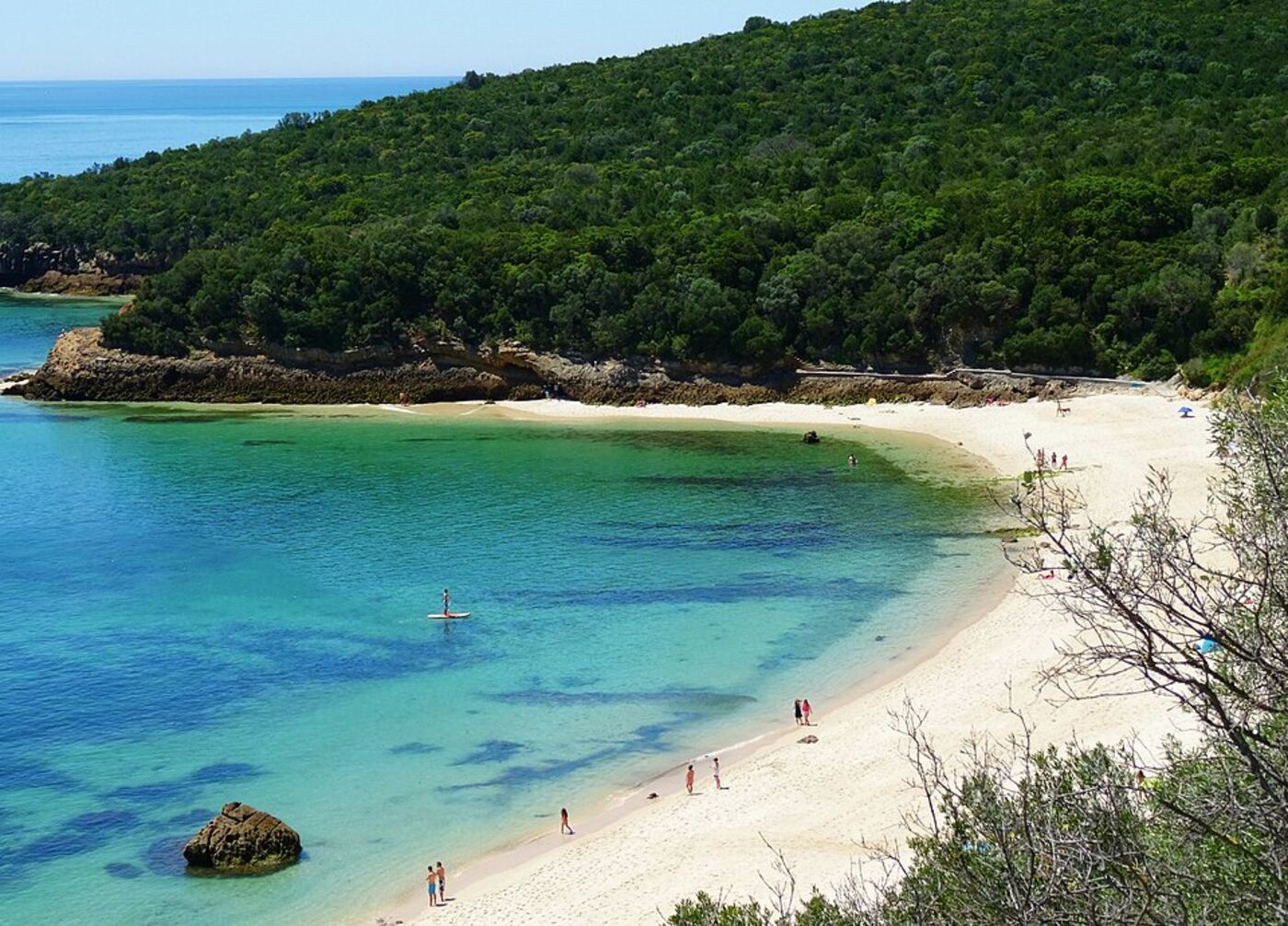
Portugal's Ministry of Environment reaffirmed this week that beaches remain part of the public maritime domain, saying no court has yet ruled otherwise, a direct response to ongoing legal action seeking to have five beaches inside the Arrábida Natural Park declared private property. The Setúbal municipal council said much the same on 10 July: officials remain confident residents will keep free access to the beaches, despite the legal challenge.
The dispute centres on the Herdade da Comenda, a large estate within the park. Its owner, Sociedade Palácio da Comenda SA, has several legal actions underway seeking recognition that five beaches, Rasca, Comenda, Rainha, Maria Esguelha and Albarquel, along with the public access road serving them, Caminho Municipal 1056, are private land rather than public maritime domain. The CDU coalition, which has pushed the Setúbal municipal government to intervene more directly in the case, says the beaches in question have been used by the public "since time immemorial."
How this escalated
Arrábida has carried protected status in various forms since the 1970s, and today forms part of the Arrábida Natural Park and the UNESCO-designated Arrábida Biosphere Reserve.
Opposition to the legal challenge has steadily grown over the past month. The CDU coalition presented formal proposals to Setúbal's municipal council and assembly in late June, pushing the council to pursue every available legal avenue and demanding that the central government, the port authority (APSS), the nature conservation institute (ICNF) and the environment agency (APA) all act to defend the public maritime domain. On 30 June, Azeitão's parish assembly approved a motion, put forward by Chega, categorically rejecting any privatisation, appropriation or access restriction affecting the Arrábida beaches.
Bloco de Esquerda's Setúbal branch separately launched a petition calling for the beach-ownership dispute to be debated in the Assembleia da República. Organisers say it gathered the signatures needed in record time, with unusually strong in-person support, and was delivered to parliament in early July, timed deliberately to arrive before the parliamentary summer recess. A first public march in defence of Arrábida has already taken place; a second is planned for 19 July, including a community picnic and what organisers describe as a human chain reaching the gates of the Palácio da Comenda itself. On 16 July, the Associação dos Cidadãos pela Arrábida e Estuário do Sado added its own public appeal, calling on both the national government and the municipal council to intervene directly to restore public access.
Independent of the ownership dispute, access to the Arrábida beaches has already been restricted this year for a different reason. Storms in January and February brought down hundreds of trees and damaged slopes and embankments along the main access road, and a roughly 2,000-tonne rock formation between the Galapos and Figueirinha beaches has been flagged as a collapse risk. In response, Setúbal's council has leaned further into restricting private car access and pushing visitors toward public transport, a policy already common in peak summer months, now applied more strictly. Anyone planning a visit this summer should expect the seasonal bus service and car restrictions regardless of how the ownership case is resolved.
What visitors need to know
Arrábida's beaches, Galapinhos, once named Europe's most beautiful beach, along with Figueirinha, Portinho, Galapos and the smaller coves nearby, are among the most popular day-trip destinations for anyone living in or around Lisbon, expats included. The ownership claim remains unresolved, but for now the beaches remain open and both the national government and Setúbal's council maintain they remain part of the public maritime domain. Anyone heading to the Arrábida coast on 19 July should also expect the planned protest march and heavier-than-usual crowds around the Comenda area.