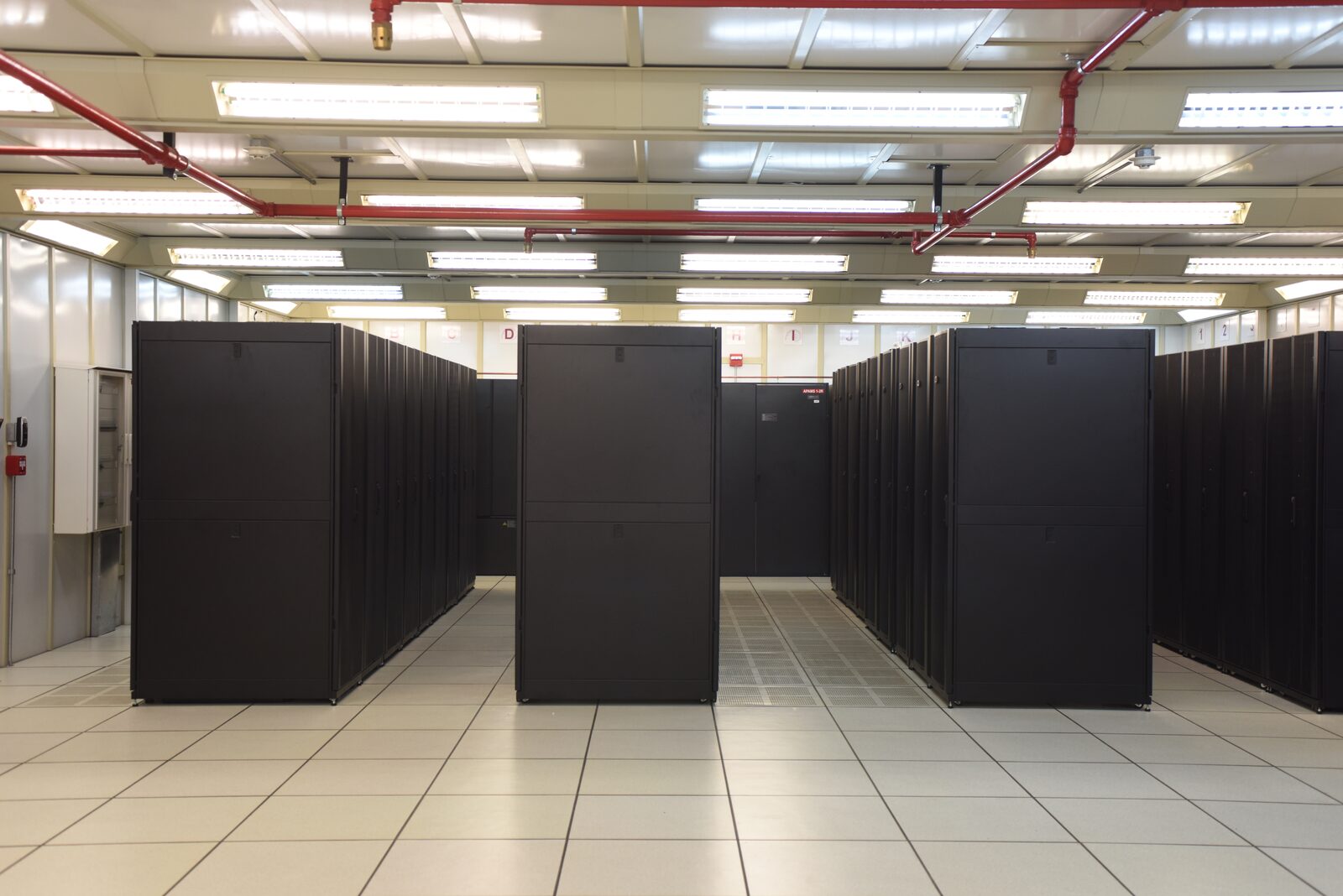
Speaking at ECO's .IA Conference in Lisbon this week, Infrastructure Minister Miguel Pinto Luz put the government's position on data centers about as bluntly as a minister ever does: Portugal wants the investment, but "we don't want to be almost the landfill of Europe." Data centers, he said, carry an "absolutely astronomical" energy cost, and don't always come with much benefit attached beyond the electricity bill. That's the tension running underneath Portugal's push into this industry: Portugal has spent the past year courting this industry aggressively, while its own infrastructure minister worries out loud that winning the courtship might just mean becoming Europe's server room, buildings, land and electricity sold cheap, with the real value captured somewhere else.
Until last year, the largest data center in the country was one Altice Portugal opened in Covilhã back in 2013: a Tier III-certified facility on a 75,500-square-metre site, about 12,000 square metres of which is actual server-hall floor space, the rest being grounds and supporting infrastructure, cooled with outside air and rainwater rather than energy-intensive chillers. Around Lisbon, a smaller cluster serves corporate clients directly, atlasEdge in Carnaxide, a Merlin Properties facility going up in Vila Franca de Xira, plus Claranet, Tata Communications and Equinix. As of 2024, Portugal's entire installed colocation capacity was a modest 39 megawatts. That's the baseline. What's happened since is a different order of magnitude entirely.
Sines
Start Campus, a US-backed developer, is building a 1.2-gigawatt data center campus on the Alentejo coast at Sines, construction alone priced at over €8.5 billion, funded privately by Davidson Kempner Capital Management and Pioneer Point Partners, with no state subsidy or EU funding involved, the company says. Its first building, SIN01, switched on in April 2025 as the largest data center in the country, cooled with seawater instead of freshwater and run on renewable energy the company procures to match its load, rather than drawing straight off the existing grid.
What turned Sines into an international story is who's paying to use it. Microsoft announced plans to deploy up to $10 billion worth of AI computing capacity through UK cloud provider Nscale at the campus, microsoft's president Brad Smith made the announcement at Web Summit in November 2025, but the mechanism matters: Microsoft isn't taking equity in Start Campus, it's paying Nscale for capacity, and Nscale is the one deploying the hardware, in this case over 12,600 Nvidia Blackwell Ultra GPUs. In May 2026, Nscale added a second commitment: more than 66,000 Nvidia Rubin chips from late 2027, backed by €230 million in shared infrastructure and €465 million for a new 200-megawatt building. Start Campus CEO Robert Dunn has floated a figure of up to €30 billion in combined infrastructure and tenant investment across the campus's lifetime, that's not the campus's cost, it's Dunn's own optimistic total once future customers who haven't signed anything yet are folded in.
This is the version of the Sines story that gets told at ribbon-cuttings. It is a real, large, functioning industrial project. It is not the whole story, and the minister's "landfill" line is really a question about what happens on top of it.
What the government is actually trying to buy
The most direct answer Portugal has given so far isn't the National Data Center Plan, it's the gigafactory bid, and it's worth explaining what that actually is, because it's not the same thing as another Sines. An EU "AI gigafactory," under Brussels' InvestAI programme, isn't a commercial server farm renting space to whoever shows up; it's a publicly-anchored compute facility built around roughly 100,000 advanced AI processors, intended to give a country or bloc sovereign capacity to train and run its own frontier-scale AI systems rather than renting all of it from American hyperscalers. The European Commission is funding five of these across Europe, at €20 billion combined. Portugal and Spain have filed a joint bid, led on the Portuguese side by the Banco Português de Fomento, with Sines as the lead site and Abrantes floated as a backup for redundancy. In June, Portugal's government committed €200 million in public money to the bid, a sum Brussels would match if selected, doubling it to €400 million, on top of billions more in expected private capital. A decision isn't likely before autumn.
The distinction matters because it's the difference the minister is actually gesturing at. A hyperscaler leasing GPU capacity at Sines is Portugal renting out land, power and cooling. A gigafactory, if Portugal wins one, is Portugal owning a stake in the compute itself, the closest thing on offer to the "more than a landfill" outcome Pinto Luz says he wants.
The plan meant to speed all of this up
Layered under both is the Plano Nacional de Centros de Dados, approved in March and published in April: in practice, it means AICEP becomes a single point of contact for investors instead of a maze of agencies, land can be pre-zoned and pre-licensed before a specific developer shows up, and licensing gets fixed maximum timeframes for the first time. The government's own projection is aggressive, roughly 41% annual capacity growth through 2030, about double the European average. Industry reaction has been welcoming but pointed: Portugal DC's president called it "ambitious," then added that turning a plan into actual approvals is "the hard part." The trade association's own separate forecast is bolder still, a 44-fold capacity increase by 2031. Read that one as the industry's own optimistic number for itself, not an independent projection.
Who actually pays for the grid
Data center developers have reportedly filed grid connection requests totalling around 26.5 gigawatts nationally, not approved projects, not committed demand, just requests, but ones that, if even a fraction convert to real load, comfortably exceed Portugal's entire installed generation capacity of roughly 23 gigawatts and dwarf the country's historical peak demand of under 10 gigawatts. Portugal remains a net electricity exporter, with about 71% of 2024 consumption coming from renewables, though that export position varies seasonally and isn't a fixed cushion. Industry figures speaking at an ECO panel in February described the current build-out as a real "jolt" to the grid regardless, one that will require serious new investment in REN's transmission network and E-Redes' distribution network no matter how individual projects structure their own power deals.
Start Campus says its own model avoids passing costs to ordinary consumers, building its own substation and working with EDP to add generation matched to its own growth rather than drawing down existing supply. The harder-to-dismiss counterpoint: whatever private generation a developer lines up, the public grid still has to guarantee redundant capacity at peak demand regardless of weather or contracts, and those costs ultimately have to be recovered somehow, either through tariffs spread across everyone, or through the kind of dedicated-generation requirements the US and Ireland now impose on hyperscalers as a condition of connecting at all. Portugal hasn't adopted anything like that. A separate voice on that same February panel, Visabeira's operations chief, flagged something more immediate than grid capacity: a skilled labour shortage, with Portuguese technicians in this field being actively recruited away to France, Germany, Denmark and the Nordics faster than the domestic pipeline can replace them.
Start Campus's Sines campus directly employs around sixty people today, by its own account, alongside roughly 700 construction jobs generated through its supplier chain during the building phase, worth holding up against the thousands cited in government and industry projections for the sector's future. In Abrantes, where a smaller project has been proposed, the PCP/CDU has publicly challenged the local mayor's claims of 400 direct and 700 indirect jobs by 2030, arguing the figures were presented with no accompanying environmental or social impact assessment. Data centers are real capital investment. Historically, they are not large direct employers relative to the sums involved, and most of the multi-thousand job figures attached to this sector nationally are construction-phase or indirect estimates, not permanent operational headcount.
The part that doesn't show up in ribbon-cutting photos
Sines' path here hasn't been clean. The land Start Campus is building on is managed by AICEP, which sold the surface rights for 50 years; reporting by Público found the project's environmental impact assessment was narrowed to cover only a protected area rather than the development as a whole, a scope a biologist from the conservation group LPN argued sidestepped a fuller look at alternative sites with less social and environmental impact. That reporting surfaced through Operação Influencer, the corruption investigation whose fallout brought down António Costa's government in November 2023. It's important to be precise about what that means and doesn't: the inquiry examined pressure applied to local officials over renewable energy and industrial licensing across the Sines area broadly, of which the data center land deal was one thread among several, no court has found the project itself unlawful, and Costa's government did not fall because Start Campus specifically was proven corrupt. Separately, a citizens' coalition including the Grupo de Ação e Intervenção Ambiental (GAIA) is still pursuing a legal challenge over cork oak felling tied to a wind farm supplying the area's industrial projects, and in June Start Campus itself acknowledged a legal dispute between EDP and the state over seawater intake rights could delay the cooling system its design depends on.
None of that makes the investment fake, €8.5 billion in private construction spending and functioning renewable-powered infrastructure are real. But the same project that's Portugal's best answer to "can we do this well" got there partly through a permitting process critics say received unusually narrow environmental review, and readers should hold both facts at once rather than picking whichever makes a better headline.
Portugal isn't really debating anymore whether to build data centers, the investment is arriving regardless of what anyone decides. What's still genuinely open is which of two outcomes it ends up with: a country that mainly sold land, electricity and streamlined permitting to infrastructure someone else profits from, or one that used this moment to build the skilled jobs, sovereign compute and industrial capacity that would make the "landfill" line untrue in hindsight. The gigafactory decision this autumn is the closest thing to an early answer.