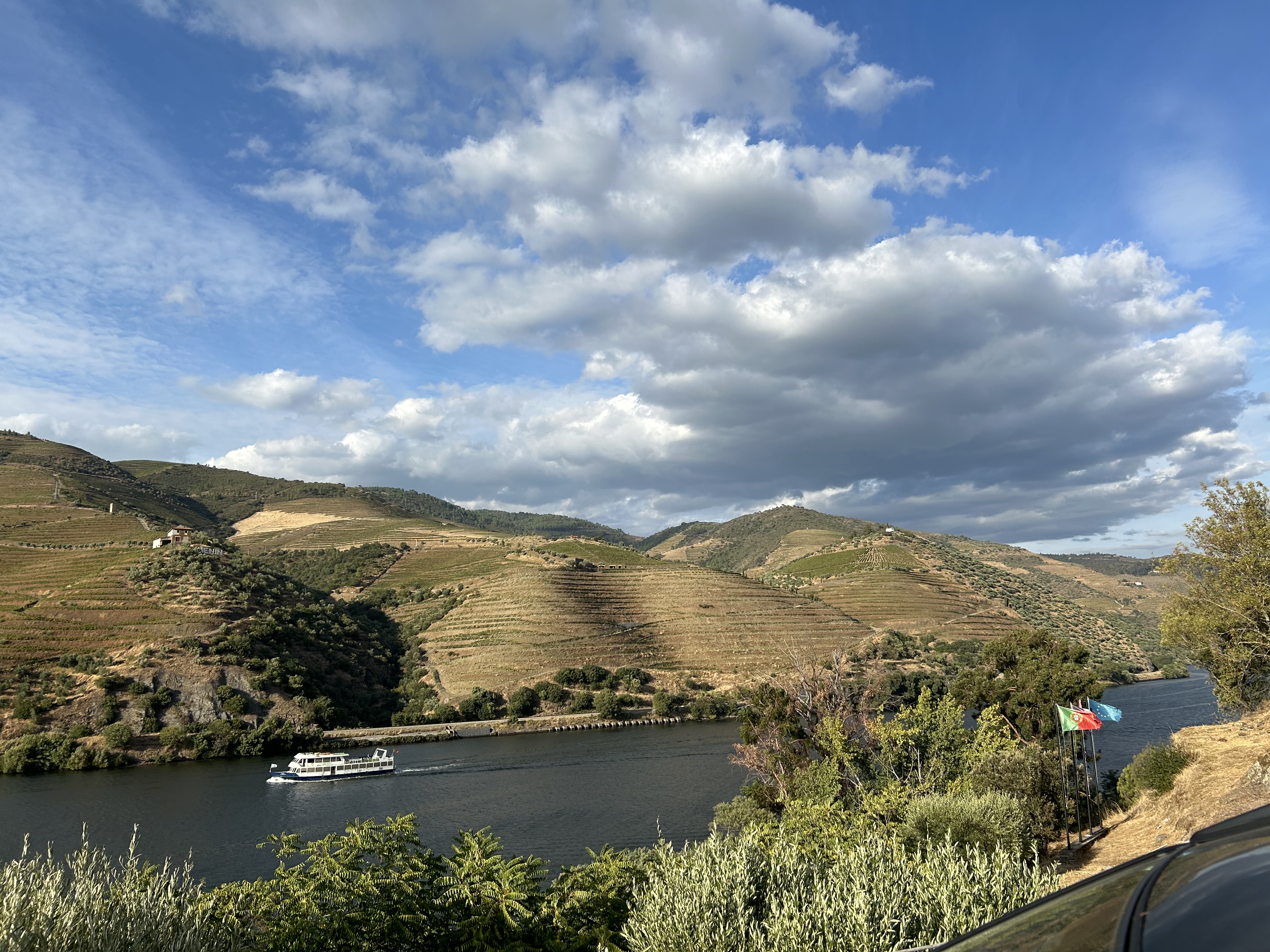
The Associação das Atividades Marítimo-Turísticas do Douro (AAMTD), which represents companies running river cruises and tourist boats on the Douro, is calling for the creation of a port administration dedicated exclusively to the river, arguing that growing river tourism is straining locks, quays and navigation-support services beyond what the current setup can handle. The Administração dos Portos do Douro, Leixões e Viana do Castelo (APDL), which currently administers the waterway, says it has already presented operators with a proposed management and operating model, and that the document will follow standard legal procedures before approval by the relevant government bodies.
The dispute has a deadline attached to it. In an earlier public statement reported by Lusa in early August, the AAMTD said most of the current private-use licenses on the waterway are due to expire in 2027, and that operators had gone months without a clear answer on what replaces them.
A river running near capacity
According to APDL figures cited by the AAMTD, the Douro carried 1,388,646 passengers in 2025, the eighth consecutive year of growth. The AAMTD put the sector's annual economic impact at between 350 and 450 million euros and estimated it supports between 6,000 and 8,000 jobs. Demand is driven mostly by visitors from the United States, the United Kingdom, Canada and Australia. According to the association, the Douro has shifted from a stopover on a wider itinerary to a primary destination in its own right, driven by river cruises, wine tourism, food and culture.
That growth is running into installed capacity. The AAMTD cites a preliminary version of an APDL study which found the locks are already operating close to their limit during peak periods. The association also points to a shortage of mooring berths and service quays for water, power, waste collection and logistics support, with the worst bottlenecks in the estuary and at Régua, Pinhão, Lamego, Pocinho and Barca d'Alva. The result, the AAMTD says, is longer wait times, harder trip planning and added costs, and on hotel ships, water-supply limits have already forced operators to bring in water by tanker truck.
- New quay at Freixo, estimated at 7.5 million euros
- Expansion of the Secil quay, 3.5 million euros
- Improvements in Gaia, including at Cavaco, plus fixes sought for Douro Marina, Afurada and Atães
- Near Régua and Pinhão: 6.3 million euros to reorganize and expand the Sabrosa quay, 3.4 million for a service quay at Adorigo, and 2.6 million for work at Foz do Távora
- Further upriver: investment flagged as relevant at Ferradosa (São João da Pesqueira), Moncorvo and Pocinho (Vila Nova de Foz Côa)
- Barca d'Alva: expansion of the existing quay for six more hotel ships, about 6.3 million euros, plus a possible second, privately funded quay costing around 7 million
The AAMTD separately criticizes the absence of any plan for the Port of Lamego.
What operators are asking for on licenses
The AAMTD says its members are willing to help fund these investments, but want stable rules in exchange. The current regime has been described as allowing licenses of seven to 10 years in earlier reporting, while the AAMTD itself puts the figure at 10 or 15 years; either way, the association argues that is incompatible with vessels and infrastructure costing several million euros with amortization periods that run longer than two decades. Its own proposal is for concessions or use permits lasting at least 25 to 30 years, a narrower range than the 35-year terms it separately cited, also in early August, as the benchmark used on other European waterways and port areas.
The AAMTD says it does not dispute paying fees for use of the waterway, but questions whether the revenue the sector generates is actually returning to the Douro as investment, pointing to a gap between rising charges and improvements in services. Among the gaps still cited: quay electrification, support structures, up-to-date information on river flow and navigability, and adequate waste-management systems. The association is also calling for modernization of the navigation information system and marine signage.
The core complaint: no single voice in charge
The AAMTD wants more effective coordination between APDL, the Agência Portuguesa do Ambiente, EDP, REN, the maritime authority, Turismo de Portugal, riverside municipalities and the operating companies themselves. For the association, the problem is not a shortage of institutions but that no single body has the authority to set direction. Its proposal is a Douro Port Administration with its own autonomy and accounts, or, failing that, a permanent structure empowered to coordinate decisions and carry out investments.
The AAMTD is also renewing its call for a National Strategic Plan for the Douro Navigable Waterway, this time framed around priorities for the next 10 to 15 years, a longer and more specific horizon than the 2030 target the association cited when it first raised the idea in May.
What's at stake
The AAMTD's concern is that continued growth without matching infrastructure will mean more congestion, higher operating costs and a worse experience for passengers. Its broader argument is that the Douro does not lack studies or diagnoses; it lacks the investment needed to turn those plans into infrastructure.