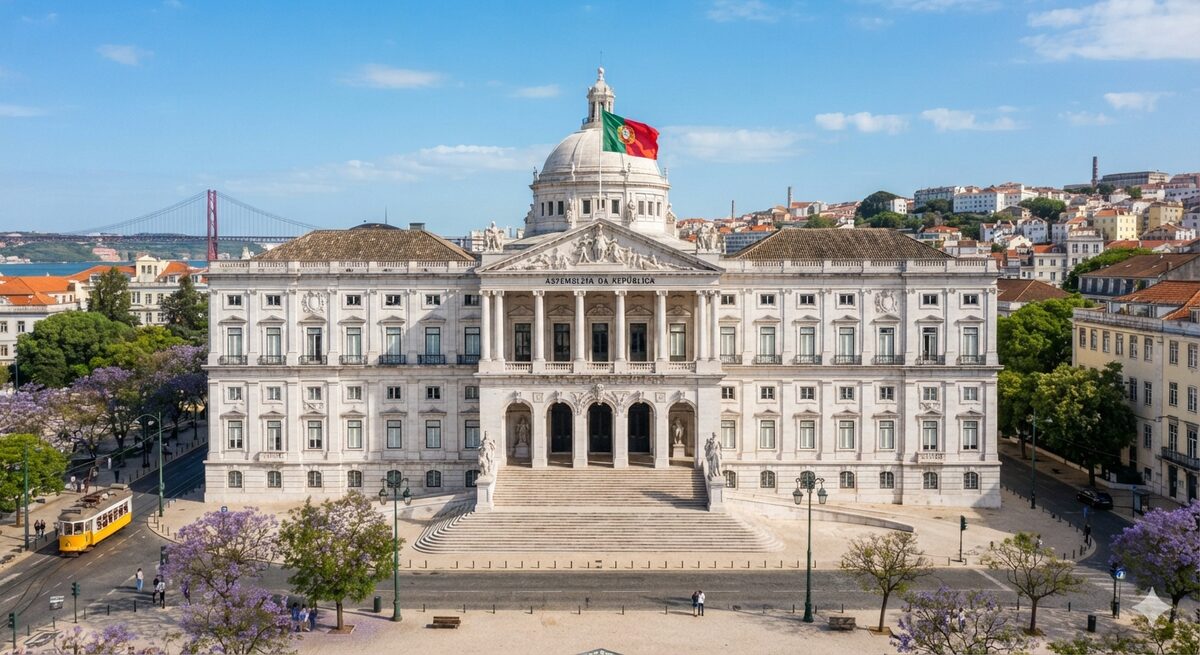
A parliamentary committee approved a revised version of Portugal's face-covering ban on Thursday, nine months after the original proposal first cleared a floor vote and then sat stalled for most of the time since. The bill's substance has shifted noticeably in that gap, but the debate over what it's really about hasn't.
What was voted
PSD, Chega, Iniciativa Liberal, and CDS voted the bill through the Committee on Constitutional Affairs, Rights, Liberties and Guarantees; PS, Livre, Bloco de Esquerda, PCP, and PAN voted against. It's the same lineup that approved the bill in its first, general vote back in October, meaning nine months of negotiation moved the text considerably without shifting a single party's position.
The bill, which originated with Chega and became known in the press as the "lei das burcas" ("burqa law"), bans concealing one's face in public spaces. It still needs a final floor vote before becoming law, and given constitutionality concerns already raised by the Bar Association and the Public Prosecutor's Office, a Constitutional Court challenge before or after enactment is a real possibility.
What actually changed
In June, PSD introduced a substitute text that reframed the bill entirely around public security rather than religious dress, dropping any explicit reference to burqas from the title. Chega initially threatened to vote against its own bill's replacement, but on Wednesday night, hours before the vote, the party introduced its own new substitute text that moved sharply toward PSD's framing, apparently to head off exactly the constitutional challenge already flagged by legal authorities.
The practical changes are real. The bill's title changed from banning face-covering "except in certain exceptions" to banning it "for reasons of security and public order." The list of protected reasons someone can't be forced to cover their face expanded from gender and religion to include age and origin as well. And the penalty regime was softened considerably: Chega's original bill treated forced face-covering as a criminal offense (coação) carrying up to three years in prison, with a harsher sentence if the victim was a minor. The revised version downgrades this to a regulatory fine, €150 to €750 for negligent violations, €400 to €3,000 for intentional ones.
The reframing didn't survive contact with the floor debate
Despite PSD's insistence that the bill is now purely about public security, the actual remarks from its own coalition partners suggested otherwise. Chega's Madalena Cordeiro argued lawmakers needed to stop pretending all cultures are equal "even when some deny fundamental principles of our civilization," warning against accepting the return of "symbols that mean silence and oppression." Iniciativa Liberal's Rui Rocha, notably, criticized his own coalition's security framing directly, calling it a form of "moral cowardice" and arguing the real issue was women's dignity, not public safety. PSD's own vice-president, António Rodrigues, held the line that the bill "stopped being the burqa law to become a bill about security."
PS vice-president Pedro Delgado Alves, explaining his party's opposing vote, said the Islamophobic intent behind the original bill's stated reasoning couldn't be ignored regardless of the rewrite, and pointed to a parliamentary hearing of the Islamic Community of Lisbon that he described as having been conducted in an "inquisitorial" manner.
The left's core objection
PS, Livre, Bloco de Esquerda, PCP, and PAN opposed the bill on two grounds: that it represents a disproportionate restriction on individual and religious freedom, and that its practical impact would be minimal regardless, given how few people in Portugal actually wear burqas or niqabs. Portugal has one of the smaller Muslim populations in Western Europe, and full-face veiling within it is rare.
Portugal isn't the first to do this
France, Belgium, Austria, Denmark, and Switzerland have all passed some version of a public face-covering ban, at various points citing security, social integration, or the protection of constitutional values. Several of these laws have reached the European Court of Human Rights, which has generally granted member states latitude to legislate in this area, provided the rules respect proportionality and fundamental rights, the exact standard Portugal's own Bar Association and Public Prosecutor's Office have already suggested this bill may not clear.
Planned protests under the banner "Não nos Atirem Burcas para os Olhos" are expected in Lisbon, Porto, and Braga as the bill heads toward a final vote.