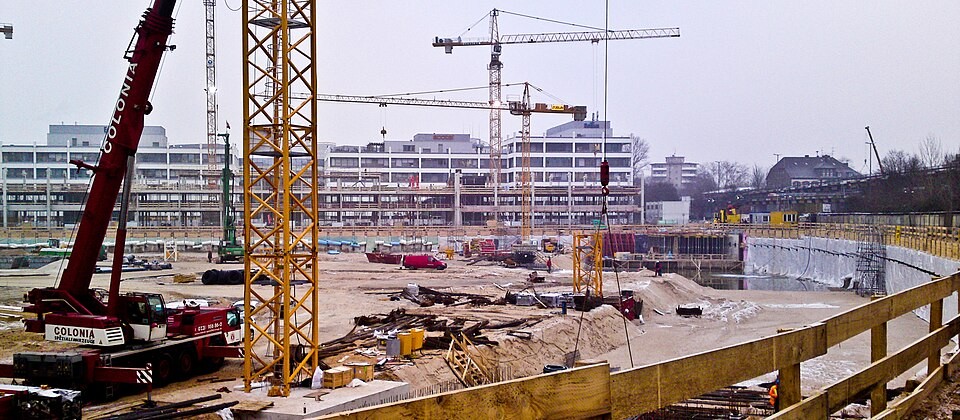
Foreign workers account for roughly 30% of Portugal's construction workforce, according to Reuters reporting on sector estimates, filling a gap left by Portuguese tradespeople who moved abroad for better pay. Since 2024, Portugal's government has repeatedly tightened immigration rules amid growing political pressure over the issue following Chega's electoral gains. Those two facts are now colliding: the country needs the workers it's making harder to bring in, right as it launches its biggest affordable-housing push in years.
The numbers behind the squeeze
The number of foreign citizens registered as residing in Portugal more than doubled between 2021 and 2025, reaching a record 1.6 million people, 14% of the country's population, according to INE figures confirmed by the government in June. That growth traces back to 2017, when Portugal introduced the "manifestação de interesse" system, letting many foreign nationals already working in the country apply for residence permits after documenting a year of employment. Construction absorbed a disproportionate share of that wave.
The political cost became impossible to ignore. Chega, founded by André Ventura in 2019 with a single parliamentary seat, took 12 seats in 2022, 50 in the 2024 election, and 60 in May 2025, enough to overtake the Socialists and become the country's main opposition party for the first time. Prime Minister Luís Montenegro's centre-right government responded with a string of restrictions: a June 2024 decree scrapping the old "manifestação de interesse" residency route, an amended entry-rules bill passed in October 2025 after the Constitutional Court struck down an earlier version, and a nationality law, in force since May 19, 2026, that stretched the citizenship wait from five years to ten (seven for EU and Portuguese-speaking-country nationals).
The effect shows up clearly in the numbers: net immigration averaged about 13,200 people a month in 2024 and roughly halved to 6,200 a month in 2025, according to Banco de Portugal's Economic Bulletin. The central bank projects net immigration will remain well below pre-2024 levels.
A housing target the labour force can't support
The timing is awkward. The central bank puts Portugal's housing shortfall at around 300,000 homes nationwide, equivalent to Lisbon's entire housing stock, while new-lease rents have nearly doubled since 2017. The government's answer is a €9 billion, EU-backed plan to build 150,000 affordable homes by 2030.
But builders say they don't have the crews for it. Construction jobs grew 34% between 2020 and 2025, yet AICCOPN, Portugal's largest builders' association, says the sector still needs 80,000 more workers just to keep current projects on schedule. In its 2026 Economic Survey of Portugal, the OECD found 75% of construction firms cite a shortage of skilled staff as their main obstacle to doing business, the highest share of any sector it measured, and up from 25% in manufacturing.
Reuters, which first reported on the sector's mounting labour crunch this week, spoke with José Simão, a bricklayer who arrived from Angola in 2022 and now isn't sure he'll be allowed to stay, and with João Sousa, chief executive of JPS, one of Portugal's largest developers, where about 90% of the roughly 700-800-strong workforce is foreign. Sousa told Reuters the shortage now cuts both ways: builders need more workers to build homes, even as they're expected to arrange housing for the immigrants who'd fill those jobs, and warned that without action, projects risk stalling. Builders say that ratio is typical across the industry, though smaller firms have far less capacity than JPS to house workers near remote job sites.
The fixes so far are narrow
The government has opened side doors rather than reopen the main one. A fast-track "Green Lane" visa scheme has issued roughly 28,400 work permits in shortage occupations in its first ten months, according to OECD figures, but take-up in construction specifically has been limited, since the route still requires employers to arrange contracts and housing before a worker arrives, the same constraint builders already struggle with. AIMA separately launched a training programme, Integrar para a Construção, in partnership with the IEFP and AICCOPN in June 2026; it opened with a roughly €2.5 million budget and room for 500 participants, split across 25 groups, with applications closing July 5.
Existing workers face friction too. Under the revised rules, many applicants now find themselves needing formal proof of accommodation, often in the form of a registered rental contract, a document many low-wage migrant workers don't have, since informal room-sharing arrangements are common in a rental market already squeezed by the same shortage the construction sector is supposed to be fixing.
Diverging from the neighbours
Portugal's approach now stands apart from Spain and Italy, which face similar labour gaps but are moving the other way. Spain approved a decree in January 2026 to regularise roughly 500,000 undocumented migrants, naming construction as one of the sectors it aims to help; Italy has approved a three-year migration decree issuing close to 500,000 work permits to non-EU nationals between 2026 and 2028. Oscar Afonso, an economics professor at the University of Porto, told Reuters the restrictions came "too much and too quickly given the country's needs", calling it a political choice rather than an economic one, given how essential immigrant labour has become.
For now, the housing plan and the immigration rules are pulling in opposite directions, and neither side shows signs of giving way first.