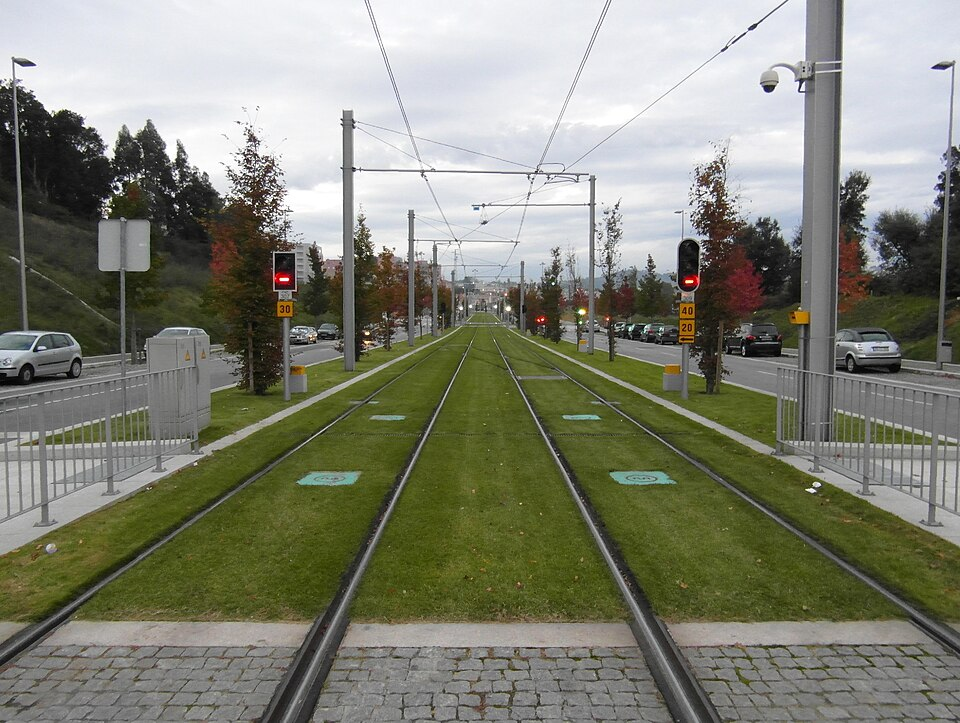
A new Metro do Porto line connecting Gondomar's town center to the Estádio do Dragão would make that trip in 20 minutes and 28 seconds, including 30-second stops at each station, according to Metro do Porto's own figures given to Lusa. The preliminary study for the line, called Dragão–Souto, opened for public consultation on August 5 and runs through September 15, via Portugal's environmental agency (APA) on the participa.pt portal, as part of the project's environmental licensing process.
The Dragão–Souto route would operate as an extension of Porto's existing metro network rather than as a standalone line, connecting Gondomar to the shared trunk section between Senhora da Hora and Estádio do Dragão, served by the A, B, C, E, and F lines, similar to how the existing Orange (F) line already extends from Senhor de Matosinhos to Fânzeres.
The route
The line runs 6.9 kilometers with nine stations: São Roque, Cerco, and Parque Oriental in Porto, then Lagoa, Valbom, Hospital Fernando Pessoa, Cosme Ferreira Castro, Oliveira Martins, and Souto in Gondomar. The route combines surface track, tunnels and a viaduct, including three separate tunnels, between Dragão and São Roque, between Lagoa and Valbom, and near Hospital Fernando Pessoa, plus a 125-meter viaduct over the Rio Torto between Parque Oriental and Lagoa. Two route alternatives are still being weighed for the Parque Oriental to Lagoa section, one fully underground, one at surface level.
The Souto terminus would sit next to the current bus terminal, which the project would rebuild into a multimodal plaza integrating different transport modes with public leisure space.
Who would use it
The study projects 10.3 million passenger journeys in the line's first full year of operation, with 4.2% of that coming from newly induced demand rather than riders shifting from other options. It estimates that would pull 1.4 million trips away from private vehicles and 3.3 million away from other public transport (STCP buses, private operators, and rail), while growing total ridership across the whole Porto Metro network by 9%. The study puts the resulting time savings at 247,539 hours a year for former drivers and 661,390 hours a year for other public transport users.
New-rider capture varies sharply by station. It's highest at Cerco (98%), Valbom (92%), and Hospital Fernando Pessoa (73%), stations serving areas with new transit access. It's lowest at Parque Oriental (8%), Lagoa (4%), and Souto (10%), where most riders already use the Metro network today.
The cost-benefit case, and its own admitted weak spot
The preliminary study's cost-benefit analysis concludes it "generates economic, social, and environmental benefits greater than its costs, leading to a gain in social welfare that justifies its implementation." That conclusion comes with a caveat stated directly in the study itself: financially, the project shows a negative net present value and an internal rate of return below the financial discount rate. In plain terms, considered purely as a financial investment, it's not expected to pay for itself financially. The case for building the line instead rests on a separate economic analysis, which found a positive economic net present value of €11 million and an economic internal rate of return of 5.15%, above the 5% social discount rate used as the benchmark.
Construction is estimated at €146.9 million to €163.8 million, and would require removing up to 533 trees, a number that could drop to 394 depending on which of the two Parque Oriental to Lagoa route alternatives is chosen, and demolishing 24 buildings.
Timeline and funding
The line already has funding secured through the EU's Sustentável 2030 program, which has allocated €225 million split between this line and a separate line to Trofa. Once approved, construction is expected to take about three years. In January, Metro do Porto president Emídio Gomes said the tender for the line's design and construction would be launched sometime this year.