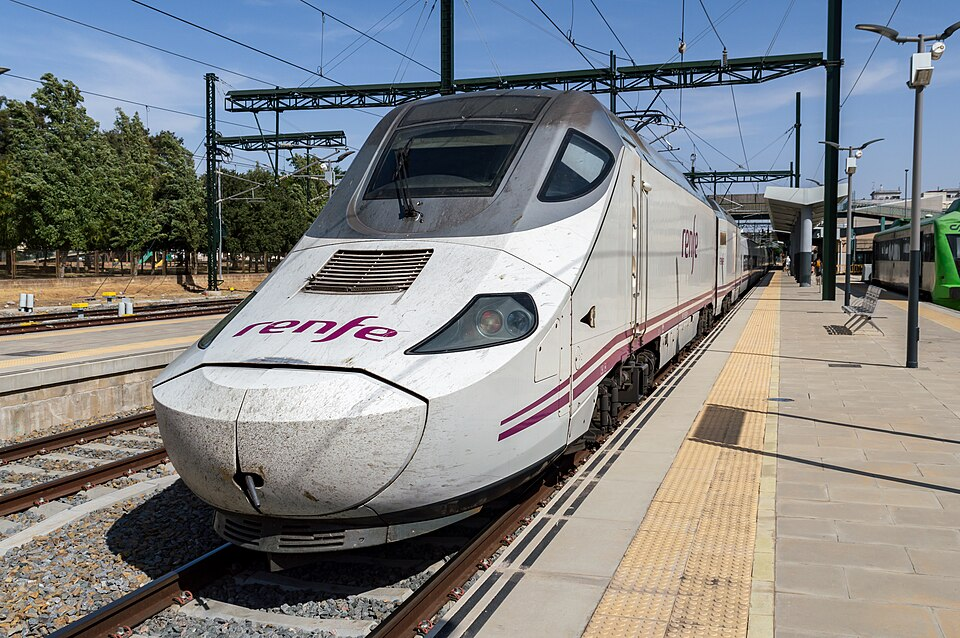
Spain's state rail operator Renfe is moving to make sure that whenever a high-speed line finally connects Portugal to the Spanish network, it's the one running the trains. The company has signed a deal with manufacturer Talgo to convert 15 of its Series 106 "Avril" high-speed trains from fixed to variable gauge, hardware that lets a train switch automatically between Spain's largely standard-gauge high-speed tracks and the Iberian-gauge lines Portugal is building. Portugal's tracks are going in at Iberian gauge for now, though with special dual-fastening sleepers designed to allow conversion to European standard gauge later, should Brussels' push for a continent-wide gauge eventually reach the Portuguese network. Officials at Spain's Ministry of Transport told the Spanish business daily Expansión the conversion is meant to give Renfe first-mover advantage across the whole Iberian market.
Representatives of Pedro Sánchez's government told the paper Renfe would initially be the only operator with a fleet ready for international high-speed service once the infrastructure exists, calling it a clear edge in the race to lead the Iberian market.
Why these trains, why now
Some of the Avril units earmarked for conversion were originally bought with an eye on expanding Renfe's service into France, with Paris as the ultimate destination. That plan stalled after Spain ran into difficulties getting its high-speed fleet certified to operate on French tracks, according to Expansión's reporting. Portugal became the fallback bet: once the 15 units are converted, Renfe will have 30 variable-gauge high-speed trains, joined in the coming months by 13 new Series 107 units, 43 trains in total, all of which would still need separate certification to run in Portugal.
It's worth noting the same contract has a more immediate, domestic rationale too. Spanish outlets reported the deal is worth roughly €132 million, with the first converted units arriving as early as October 2027, timed less to Portugal's still-distant high-speed lines than to boosting capacity on Spain's own Eje Atlántico corridor, where daily Madrid–Galicia frequencies are set to more than double. The Portugal strategy and the domestic capacity fix aren't mutually exclusive, but the Iberian-market framing is doing a lot of work in how Madrid is presenting this to the press.
Portugal isn't sitting this out
CP – Comboios de Portugal has its own ambitions for the international route. The government-approved plan already includes a tender for 12 high-speed trains, with an option for eight more, and separate approval for CP to acquire a second fleet specifically built for international service. Whether Renfe's head start on variable-gauge hardware translates into an actual competitive edge will depend on how quickly CP's own procurement moves, and on Portugal still needing to certify any operator's trains, Spanish or Portuguese, before they can run domestically. Spain's transport ministry summed up its own read on the situation simply: Portugal, as they put it, represents a major opportunity for Renfe.
Porto–Vigo high-speed rail is targeted for 2032, cutting that journey to roughly 50 minutes, with stations planned at Francisco Sá Carneiro Airport, Braga, Ponte de Lima and Valença. Lisbon–Madrid is further out: the route runs via a new Lisboa–Évora line and a planned third crossing of the Tagus, linking into Spain's network through Badajoz, Mérida, Plasencia, Talayuela and Toledo. An interim upgrade is meant to bring the journey down to about five hours by 2030, with full high-speed infrastructure, and a roughly three-hour Lisbon–Madrid trip, not expected until 2034.
Why it matters for anyone living here
There has been no direct train between Lisbon and Madrid since 2020, when Renfe discontinued its overnight train-hotel service, anyone travelling between the two capitals by rail today does it in stages, via Badajoz, with a long total journey time. A working high-speed link would be a genuine change to how expats and residents in Portugal think about regional travel, not just a novelty for train enthusiasts. But it's also a reminder of how far out these projects still are: the earliest concrete payoff, Porto–Vigo, is six years away, and the flagship Lisbon–Madrid route is eight. Today's news is about which company ends up running the trains once that infrastructure exists, not about anything changing on the ground this year.