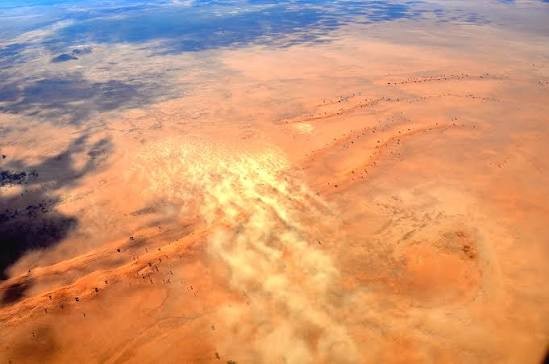
If you've noticed your car coated in orange-tinged dust more often in recent summers, new research suggests background dust levels really have been rising. A study published July 15 in Nature finds the Iberian Peninsula, Portugal and Spain in particular, is one of Europe's principal western pathways for Saharan dust, and that average airborne concentrations have climbed by roughly 10 to 25% over the past decade. It's worth being precise about what that means: the number of dust-intrusion events hasn't broadly increased over that period, it's how much dust each one carries, and how much lingers between them, that's been climbing.
A decade of measurements, and a clear trend
The study was led by Switzerland's Paul Scherrer Institute (PSI), with Célia Alves of the University of Aveiro's Centre for Environmental and Marine Studies (CESAM) among the co-authors. Researchers combined roughly 18,500 daily measurements from more than 100 monitoring stations across Europe, spanning 2012 to 2021, with a machine-learning model to estimate daily desert-dust concentrations continent-wide, the first pan-European assessment built entirely on observational data rather than modelling alone.
The result: southern Europe's average dust concentration sits at 5.3 micrograms per cubic metre of air, more than double the 2.1 micrograms measured in central and northern Europe. Across much of the continent, levels rose by about half a microgram per cubic metre over the decade studied. "That corresponds to an increase in this dust pollution of 10 to 25 percent," said Kaspar Dällenbach, the PSI researcher who led the project, in a statement from the institute. One Portuguese outlet covering the study put the longer-term rise even higher, reporting concentrations have more than doubled since the pre-industrial era.
Why Portugal specifically
The researchers name Portugal explicitly among the southern European countries most affected, alongside Spain, Italy, and Greece. The reason has to do with how the dust travels: plumes lifted off the Sahara often track out over the Atlantic before curving north, putting the Iberian Peninsula and much of western Europe directly in their path. In this western corridor, concentrations typically peak in July and August, which lines up with when Saharan dust forecasts and warnings tend to make headlines here each summer.
Notably, the data don't show more dust events hitting Portugal, the number of days classified as dust intrusions actually declined slightly across Europe as a whole between 2012 and 2021, even as average concentrations rose. The episodes that did occur became more intense mainly in southern Italy, the Adriatic, the Aegean, and parts of the Balkans; for Portugal, the study's maps point mainly to a rising average rather than more frequent intrusions.
The health and energy costs
The consequences go beyond hazy skies and a film of dust on cars and windowsills. For southern Europe, the study's authors estimate that exposure during dust-intrusion days is associated with a 0.67% rise in daily mortality and a 0.73% rise in respiratory hospitalizations among people over 15. Among children up to 14, the estimated rise in respiratory hospitalizations is 2.55%. These are regional estimates drawn from earlier epidemiological research, not a specific count for Portugal.
On days when dust concentrations spike, Portugal's health authority, the Direção-Geral da Saúde, has previously recommended that children, older adults, and people with chronic respiratory or cardiovascular conditions limit prolonged time outdoors. It's also an uncomfortable period for many people with allergies or asthma, while visibility can drop noticeably during heavier events.
Dust also cuts the solar radiation reaching the ground and settles on photovoltaic panels, reducing electricity output, a real consideration for a country that's been leaning harder on solar power. More accurate forecasting of these episodes, the researchers note, would let grid operators anticipate the dips and help keep supply stable.
What's driving it
The researchers tie the more intense recent episodes mainly to shifts in atmospheric circulation, while the longer-term rise recorded in Alpine ice cores is linked more to growing aridity and land degradation in North Africa. On the climate-change question specifically, Dällenbach was careful not to overclaim in the same PSI statement: it isn't yet clear how much human-caused warming has contributed to the trend, he said, though current understanding suggests greenhouse gas emissions are at least a contributing factor. The study's authors do note that effective climate policy could help limit the spread of arid land in North Africa over the coming decades, and with it, the long-term worsening of the problem, though that's a decades-long lever, not a near-term fix.
How to check for Saharan dust
Since this particular source of pollution can't be controlled by the countries it reaches, forecasting and public alerts are effectively the main tools available. The Agência Portuguesa do Ambiente tracks and assesses these intrusions and publishes daily air-quality measurements and forecasts through its QualAr portal. Separately, IPMA (Instituto Português do Mar e da Atmosfera) regularly issues its own advisories when a Saharan dust event is expected to affect Portugal, sometimes alongside district-level weather warnings.