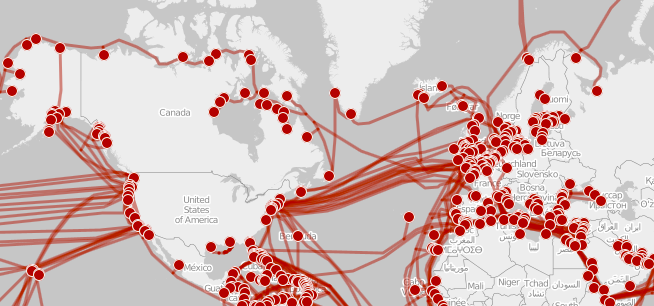
At the ceremony marking the arrival of Google's "Nuvem" cable in Sines this week, Anacom's president Sandra Maximiano told Expresso something that hadn't been reported before: Google, Meta, and other US tech companies have been quietly sounding out Portugal's telecoms regulator about installing more submarine cables here. The contacts are exploratory: meeting requests, "some intentions," nothing signed. But it's a second, separate signal on top of a project Meo announced back in October 2025: a new cable landing station and international network interconnection hub for the greater Porto area, on which Expresso asked for an update this week and got nothing. Meo said it had no "concrete data to share" yet.
Taken on its own, that's a small, hedged line from a regulator at a ribbon-cutting. Taken alongside everything else happening in Portugal's digital infrastructure right now, it's the second half of a story this outlet has already been telling about Sines: a wave of American capital arriving to build the physical plumbing of the internet on Portuguese soil, arriving faster than the government has publicly quantified what it's worth to Portugal.
The cable that keeps slipping
Nuvem itself is a useful example of how these projects actually move versus how they get announced. When Google first unveiled the cable in September 2023, it targeted 2026 for service. The company now says 2027. The Azores leg, landing at São Miguel, wasn't even part of the original route; that connection was only added in July 2024, with completion now expected in early 2027. The finished system runs roughly 7,000 kilometres from Myrtle Beach, South Carolina, through Bermuda and the Azores, to Sines, carrying up to 384 terabits per second. It's Google's first direct link between the US and Portugal, and the first transatlantic system anywhere to land in Bermuda.
Meo is the Portuguese partner and investor, distributing capacity to local business and retail customers through its own network. Neither Meo nor Google will say how much either side is actually putting into the project. That's standard practice in the industry, since cable economics are notoriously opaque, but it means Portugal is hosting a flagship piece of American digital infrastructure without either party publicly disclosing the project's commercial terms or the economic return Portugal ultimately receives from hosting it.
Nuvem isn't arriving alone. Google's "Sol" cable, announced in 2025, will connect Florida, Bermuda, the Azores and Santander with 16 fibre pairs, also targeting 2027 for its Azores leg. Sol and Nuvem interconnect at several points, including the US, the Iberian peninsula, Bermuda and the Azores, specifically so traffic can reroute around a damaged segment. That redundancy design is the whole industry's current obsession, and it's the same logic that runs through the domestic replacement projects Expresso catalogued alongside this story: Atlantic CAM, a €190.4 million project replacing the 1999-era cable linking mainland Portugal to the Azores and Madeira, due to launch in the second half of 2026 and enter service in mid-2027; the proposed Anel Açores ring, needed because seven Azorean islands still depend on a 1998 system already past its estimated working life; and a Madeira–Porto Santo replacement EMACOM is preparing before that link's 2028 expiry. The Azores' own regional president, José Manuel Bolieiro, confirmed the urgency directly at the Nuvem ceremony: the current cables' working life is already over, he said, and his government has been pushing Lisbon to replace and upgrade them. Portugal's aging domestic cable network and its glamorous new transatlantic ones are being rebuilt at the same time, by different money, for related reasons.
Taken together, a study this year by the American Chamber of Commerce in Portugal (AmCham Portugal), produced with PwC, puts Portugal on track to have 20 submarine cables anchored to its coast by the end of 2026, with a further system due to enter service in 2027. Beyond the ones already named, the roster includes Medusa, New CAM Ring, and Olisipo. The same study estimates roughly €200 million in direct investment in the cable projects themselves, and says that infrastructure underpins more than €10.3 billion in related technology and digital investment, a figure worth reading as an estimate of the broader ecosystem the cables support, not a projection for Nuvem specifically, since no comparable public estimate exists for that one project alone.
Not every new cable is American, or tied to a hyperscaler. In June, Meo's chief executive, Ana Figueiredo, told ECO that the operator will invest in a submarine cable for the first time in eleven years: a system connecting Ireland to Lisbon, officially named PISCES, and operated in Portugal by Meo's own teams. Unofficially, she said, people call it "the Brexit cable", because it will be the first system letting Ireland reach continental Europe without routing through the UK. It's a smaller, more parochial story than Nuvem's transatlantic ambitions, but it's a useful reminder that Portugal's cable landings aren't only about American capital looking for a European doorstep; some of them are about Europe rerouting around Britain.
There is no public, detailed estimate of Nuvem's economic impact. Google's language on this is aspirational rather than quantified: better connectivity "opens doors" to jobs and productivity gains. At the ceremony, US ambassador John Arrigo cited a figure of more than €500 million a year in economic impact, but that number comes from a 2021 Copenhagen Economics study Google itself commissioned, covering two other cables, Equiano and EllaLink. It says nothing about Nuvem. The Portuguese government told Expresso it has no impact projection of its own for Nuvem either, though it confirmed the project receives no public financing. This is the exact same pattern this outlet flagged in its data center coverage: real capital arriving, headline figures cited during the ceremony that referred to two earlier cables, Google's Equiano and the separate EllaLink system, rather than to Nuvem itself, and no independent number filling the gap.
Why the cables and the data centers are the same story
It's worth being explicit about the mechanism connecting these two buildouts, because it isn't a coincidence of timing. A data center campus like Start Campus at Sines is only valuable to a hyperscaler if it can move enormous volumes of data to and from the rest of the world at low latency. Large-scale data center developments depend on abundant international bandwidth. You cannot realistically market gigawatts of GPU capacity at Sines to the likes of Microsoft or Nscale if the bandwidth to actually reach US and European markets isn't sitting a few kilometres offshore. Nuvem landing at Sines, in other words, isn't decoration next to the data center campus; it's infrastructure on which the campus's business model depends. The same logic helps explain why Google has returned to Portugal with successive cable projects, and why Meta and other firms are now asking Anacom about doing the same: Portugal's Atlantic-facing coastline, EU membership, and now its data center capacity make it a uniquely convenient point to stitch American cloud infrastructure to the European continent.
Start Campus isn't the only project drawing on that same logic. Equinix already operates two data centers in Lisbon and is planning a third. AtlasEdge opened its Carnaxide campus last October, with total planned investment reaching €500 million once every building is complete. Merlin Edged has a pipeline that could reach 1.3 gigawatts in Portugal, and Digital Realty entered the Portuguese market recently with projects sited near the country's main connectivity infrastructure. Luís Pedro Duarte, president of the Portuguese data center association Portugal DC, put the relationship bluntly to ECO: "there's an old saying that data centers without connectivity are just very expensive refrigerators." Portugal's Infrastructure Minister, Miguel Pinto Luz, said in May that the country had roughly 40 pending requests for new data center installations, a number that only makes sense against the backdrop of cable capacity arriving fast enough to support them.
That's genuinely valuable positioning. It's also precisely the setup Infrastructure Minister Miguel Pinto Luz was describing when he said, of the data center boom, that Portugal doesn't want to become "almost the landfill of Europe": hosting the physical layer of someone else's business at a fixed price, while the value captured sits with the American company that owns the compute, the cloud contract, or in this case the cable itself. Cables are, if anything, a cleaner version of that dynamic than data centers: Start Campus at least builds jobs, a supply chain, and a facility Portugal can point to. A cable is a pipe passing through Portuguese waters and landing on Portuguese soil, requiring relatively little ongoing local employment once construction ends, its commercial terms and financial arrangements largely undisclosed, its economic benefit asserted rather than measured.
The sovereignty question nobody's really answering
Maximiano's own comment gestures at the tension without resolving it. Asked about the growing role of American capital in this infrastructure, she said "Europe can't close itself off." Foreign capital and European autonomy aren't inherently incompatible, in her view. That's a defensible position, and probably the correct one for a small, capital-hungry economy. But it sidesteps the harder question: submarine cables carry 99% of intercontinental internet traffic, according to the European Commission, and an outsized share of the ones now serving Portugal are being built, owned, and priced by a small number of US companies with no obligation to disclose terms to the public whose seabed and coastline they're using. US Ambassador John Arrigo made the American side of that bargain far more explicit at the same ceremony. He put a number on it: over $40 billion in US tech investment in Portugal expected by 2031, which he said would make the country "the largest concentration of American AI infrastructure investment in all of Europe," and framed each cable landing as displacement of a rival: "every trusted cable that arrives on the Portuguese coast is one that no longer arrives somewhere less reliable." He also said US policy actively works to keep "untrusted suppliers" out of any stage of this infrastructure's supply chain, adding that concern "matters to Washington, and it should matter to Lisbon too." That's a considerably sharper ask than Maximiano's neutral framing: not just that foreign capital and sovereignty can coexist, but that Portugal should treat American supplier preferences as its own policy. Arrigo's own answer to the sovereignty question was that Europe's choice isn't between autonomy and partnership, but between building its digital future "with trusted allies" or trying to build it alone and falling behind, a framing that assumes its own conclusion as much as it argues for one.
The security stakes underneath that are real, if mostly unrelated to who owns the cable. Global cable faults run 150 to 200 a year, and the International Cable Protection Committee attributes 70–80% of them to accidents: fishing gear and anchors, mostly, plus the occasional undersea landslide. But the war in Ukraine and a string of Baltic Sea cable incidents, not all of them conclusively attributed, have pushed sabotage risk up the political agenda regardless: NATO launched its Baltic Sentry patrol initiative in January 2025, and the European Commission earmarked €347 million in February 2026 for cable security and strategic projects, €20 million of it specifically for repair capacity that can be staged at ports. Brussels also opened a €200,000-a-year tender this month just to track compliance with its own cable-security measures and keep the risk map current. None of that spending addresses the ownership question Maximiano waved past: it's aimed at keeping the pipes intact, not at who profits from them once they are.
What's actually new this week isn't Nuvem. The ceremony marked progress on a project that is nonetheless running about a year behind Google's original timeline. What's new is that Portugal's telecoms regulator has confirmed, on the record, that this is an open pipeline rather than a one-off: more American tech companies are asking about landing more cables here, on top of a domestic project in Porto that's gone quiet, on top of a national data center strategy explicitly designed to make this kind of investment easier to approve. Individually, each of these is a reasonable, even attractive, piece of infrastructure investment for a country with Portugal's Atlantic position. Stacked together, they describe something larger. Whether that's ultimately a bargain or a missed opportunity isn't something the available public evidence can answer. What it does show is that Portugal is becoming a far more important node in global digital infrastructure than it was a decade ago, while the economic value of that role remains largely unquantified.