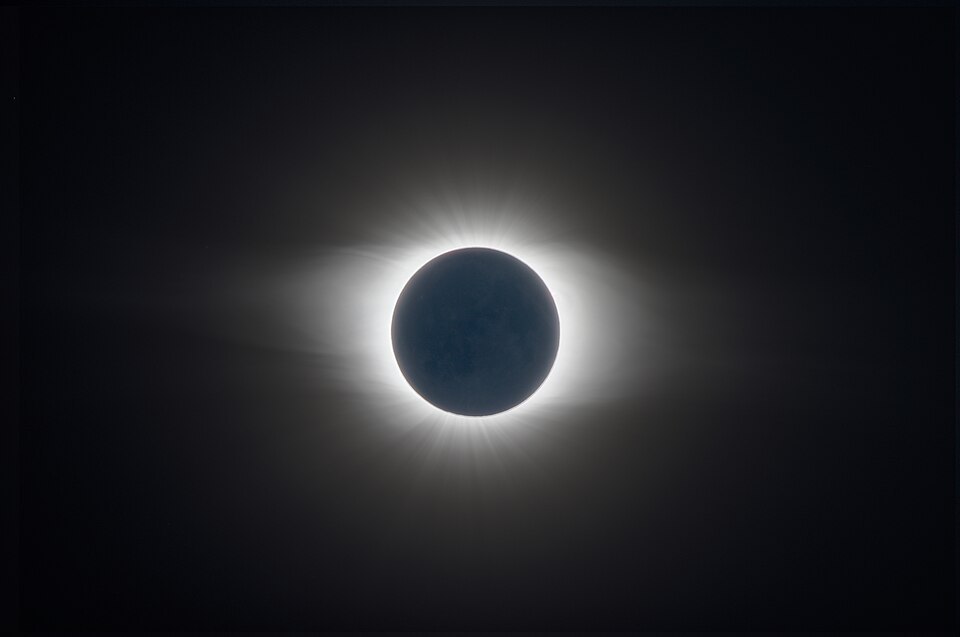
Late on Wednesday, August 12, mainland Portugal will witness its first total solar eclipse in more than a century. That afternoon, the Moon will pass in front of the Sun in a solar eclipse visible across the whole of Portugal, mainland and islands alike. For almost everyone, it will be a partial eclipse, deep and dramatic, but partial. For a fortunate few standing on one particular stretch of road in the far northeast of the country, it will be total: the Sun fully blotted out, the sky dimming like dusk in the middle of the evening, for about 26 seconds. The last time that happened anywhere in mainland Portugal was 1912. The next time will be 2144.
Where totality actually happens
The path of totality crosses mainland Portugal in exactly one place: a short section of the N308 road between the villages of Rio de Onor and Guadramil, inside the Parque Natural de Montesinho, in the Bragança district. Beyond that narrow corridor, the eclipse becomes partial again, even if barely. Totality there is expected to begin at around 19:30:17 local time and last roughly 25.6 seconds, according to figures compiled from official eclipse data. Because the event happens so late in the day, the Sun will already be low, only around 3 to 12 degrees above the horizon, sitting in the west. Anyone planning to watch from Montesinho needs a genuinely open view to the west, not just clear skies overhead.
Access to the official viewing area along that stretch of road is being managed, not left to chance. Ciência Viva, Portugal's science outreach network, is coordinating entry to the observation zone through the national Programa Nacional do Eclipse 2026, and advance registration is required to secure a spot there.
What everyone else will see
You don't need to be in Bragança for this to be worth watching. Across the rest of the country, the eclipse will still be dramatic, just not total. Coverage of the Sun's disc runs from roughly 92% up to nearly 100% on the mainland, and the rule of thumb is simple: the further north, the more of the Sun disappears. Bragança city itself will see around 99.9% coverage, still technically partial. Porto is expected at close to 98%, Lisbon around 94%. Southern Portugal sees somewhat less, though still enough to notice, the Algarve is expected above 90%. The Azores and Madeira, further out in the Atlantic, will see a comparatively modest 74% to 77%.
Nationally, the moment of greatest coverage arrives around 19:30, with the full event, from the Moon's first bite out of the Sun to its last, stretching across nearly two hours. Because it lines up with sunset for much of the country, in many places the Sun will dip below the horizon before the eclipse has technically finished.
Even at 99% coverage, an eclipse is not safe to look at with the naked eye, sunglasses included. Certified eclipse glasses meeting the ISO 12312-2 safety standard are essential for the entire event, everywhere in Portugal, for the whole nearly two hours. The one exception is the roughly 26 seconds of true totality on that stretch of the N308, when the Sun's disc is completely covered; that is the only moment, and the only place, where looking directly at it without protection is safe. Everywhere else, and at every other moment, uncertified glasses or a bare glance can cause permanent eye damage, sometimes without any pain at the time to warn you.
Bragança is already booked out
The narrowness of the totality band means demand for anywhere near it has been intense. Isabel Ferreira, the mayor of Bragança, told TSF that accommodation across the area was already fully booked, with Rio de Onor itself, the village the totality path runs past, singled out as the only spot on the mainland where the eclipse will be complete. If you haven't booked something in the district yet, the honest answer is that you're watching from wherever you already are, which, given the numbers above, is still a genuinely rare sight.
A bonus for anyone staying out after dark
Because the eclipse falls in mid-August, anyone who stays outside after sunset gets a second astronomical event in the same night: the Perseid meteor shower, one of the most reliable and visible of the year, peaks around the same period, and this year the Moon will already be out of the sky by nightfall, meaning no moonlight to wash out the fainter meteors. Several municipalities are pairing the two, including an evening event at the Ermida de Santo Amaro in Almodôvar, run with the Centro de Ciência Viva de Lagos, that runs from the eclipse straight through into meteor-watching once the Sun is down.
Where to watch, if you want company
Beyond Bragança, organized viewing sessions are planned nationwide: at the Real Observatório Astronómico de Lisboa in Tapada da Ajuda, at the Pavilhão do Conhecimento, and at Ciência Viva centers across the country, including the Exploratório in Coimbra. Bragança's own Centro Ciência Viva is running its regular Café de Ciência sessions in the lead-up. The national program was presented with Bragança mayor Isabel Ferreira, Ciência Viva director Ana Noronha, and astronomer Pedro Mota Machado of the Instituto de Astrofísica e Ciências do Espaço, who is serving as National Commissioner for the 2026 Solar Eclipse. For exact times by municipality, the official eclipse2026.pt portal lets you check your own district down to the minute.
| Location | Approx. coverage |
|---|---|
| Rio de Onor / Guadramil (N308, Bragança) | 100% (total, ~26 seconds) |
| Bragança city | ~99.9% (partial) |
| Porto | ~98% |
| Lisbon | ~94% |
| Algarve (Lagos) | 90%+ |
| Azores / Madeira | 74%–77% |
Wherever you end up watching from, this is the kind of thing worth marking on the calendar now. Portugal won't see anything like it again for over a century.